

In the wave of global manufacturing transformation towards intelligence and high-end, precision machining plays a key role as the "heart of industry". This manufacturing technology, which aims at micron-level or even nanometer-level precision, transforms design drawings into high-precision parts through core means such as CNC machining, precision testing, and special processes, supporting technological breakthroughs in cutting-edge fields such as aerospace, medical devices, and semiconductors. Its core value lies not only in the ultimate control of dimensional errors, but also in the deep coupling of material properties and processing technology to achieve a performance leap for functional components. This article will analyze how precision machining has become the core driving force for modern industrial upgrading from the dimensions of technology system, material adaptation, and industry trends.

Core technology system: three-level advanced logic of precision control
The technical framework of precision machining can be summarized as a trinity mode of "equipment precision - process optimization - detection closed loop":
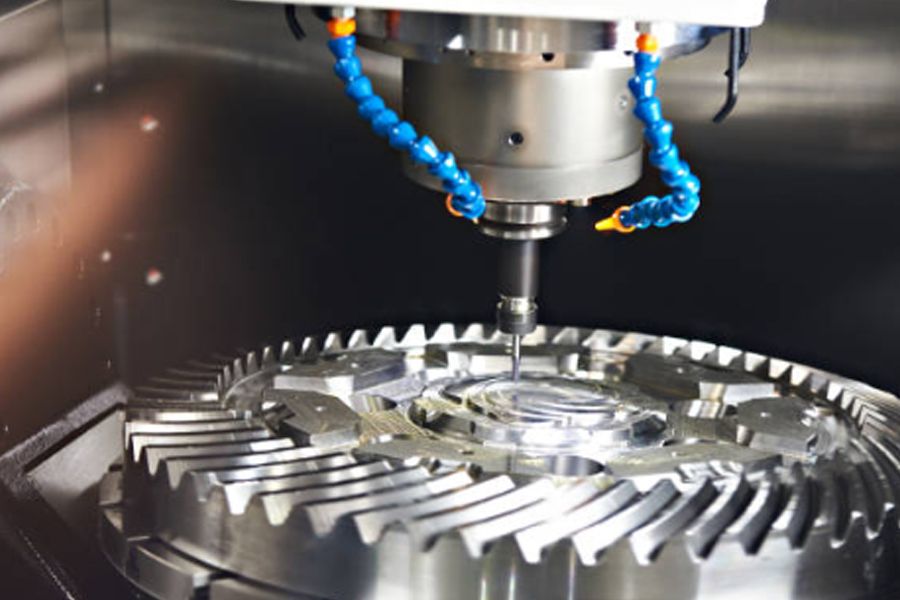
The precision base of CNC equipment: The five-axis linkage machining center realizes multi-dimensional cutting through a double swing head structure, with a positioning accuracy of up to ±5μm. With the high-speed operation of the electric spindle (speed ≥40,000rpm), it can complete the complex curved surface processing of aerospace blades. The wire-cutting machine tool uses an electrode wire with a diameter of 0.02mm to achieve micro-machining of carbide molds, and the surface roughness is controlled at Ra≤0.1μm.
Intelligent optimization of process parameters: Based on the material removal rate model, the cutting speed, feed rate and tool angle are dynamically adjusted through machine learning algorithms. For example, when processing titanium alloys, the material deformation can be reduced by reducing cutting heat (controlling temperature rise ≤80℃), and the tool life can be increased by more than 30% with vibration cutting technology (frequency 20kHz). This transformation from "empirical process" to "data process" is becoming the core path for precision breakthroughs.
Full-process detection closed loop: The three-coordinate measuring machine (CMM) uses a ruby probe to achieve 0.001mm-level dimensional detection, and combines image measuring instruments and laser scanners to build a full-process precision traceability system from blanks to finished products. The application of thermal stability compensation technology reduces the impact of ambient temperature changes on detection results to 0.0005mm/℃.
In-depth game between material properties and processing technology
The physical and chemical properties of different materials determine the technical route selection for precision machining:
High-strength metal materials (such as titanium alloys and high-temperature alloys): their high hardness (≥300HB) and low thermal conductivity (thermal conductivity coefficient <15W/m・K) lead to severe tool wear during machining. Solutions include the use of diamond-coated tools (coating thickness 5-10μm), high-pressure cooling systems (pressure ≥10MPa), and layered milling strategies (single cutting depth ≤0.2mm) to improve machining efficiency while ensuring surface accuracy.
Lightweight alloy materials (such as aluminum alloys and magnesium alloys): Although they have the advantage of easy forming, their low stiffness (elastic modulus ≤70GPa) can easily lead to machining deformation. By fixing the workpiece with vacuum adsorption tooling (adsorption force ≥50N/cm²) and reducing the cutting force with high-speed cutting (linear speed ≥2,000m/min), the shape and position tolerance of thin-walled parts (wall thickness ≤0.5mm) can be controlled within 0.05mm.
Non-metallic materials (such as ceramics, carbon fiber composites): brittle fracture and fiber delamination are the main difficulties. Laser processing technology (wavelength 10.6μm) achieves stress-free cutting through thermal ablation, and ultrasonic processing (amplitude 10-50μm) uses high-frequency vibration to crush materials. The combination of the two technologies can complete the precision processing of 0.1mm diameter microholes.
Industry application: precision penetration from cutting-edge fields to people's livelihood manufacturing
The technical value of precision processing is implemented differently in different industries:
Aerospace: The tenon accuracy (tolerance ±0.002mm) of aircraft engine blades directly affects the aerodynamic performance. The composite process of electrolytic processing and chemical milling is used to achieve burr-free processing of complex surfaces; the high-strength bolt holes (accuracy H7 level) of landing gear components rely on gun drilling technology (depth-to-diameter ratio ≥30:1) to ensure the integrity of the hole wall.
Medical devices: The surface roughness (Ra≤0.2μm) and microporous structure (aperture 50-500μm) of orthopedic implants need to be achieved through a combination of electrospark machining and electrochemical polishing to ensure bone cell attachment and growth; the optical lens (surface shape accuracy λ/10) of medical endoscope lenses relies on magnetorheological polishing technology to achieve nano-level surface accuracy.
Consumer electronics: The micro gears (module ≤0.3) of smartphone camera modules are molded by powder metallurgy injection molding, combined with precision grinding (accuracy level 4) to achieve silent operation; the solder ball spacing (≤0.4mm) of 5G chip packaging relies on visually guided micro spot welding technology to ensure the reliability of electrical connections.
Industry Trends: Intelligentization and Greening Drive Technological Change
The current precision machining industry is undergoing two core changes:
Intelligent manufacturing upgrade: The application of digital twin technology enables the machining process to be rehearsed in virtual space. By collecting 300+ parameters such as machine tool vibration, temperature, current, etc. in real time, a digital mirror of the machining process is constructed to warn tool wear in advance (prediction accuracy ≥ 90%). The collaborative operation of industrial robots and machining centers has realized the implementation of "unmanned" precision machining units, such as the fully automatic grinding production line of bearing balls, with a yield rate of more than 99.8%.
Green manufacturing technology innovation: Dry cutting technology replaces cutting fluid with air cooling (temperature - 50℃), reducing waste fluid emissions by 100%, and combined with degradable tool coating (life increase by 20%), it complies with the requirements of the EU RoHS 3.0 directive. The integration of energy recovery systems reduces machine tool energy consumption by 15%-20%, and carbon emissions per unit of output value decreases simultaneously.
Precision machining is not only a manufacturing technology, but also an innovation hub connecting materials science, mechanical engineering and information technology. From micron-level size control to nano-level surface modification, every precision breakthrough is reshaping the possibility of high-end manufacturing. With the advancement of "China Smart Manufacturing 2025" and global Industry 4.0, this technology is penetrating from "high-threshold fields" such as aerospace to a wider range of manufacturing industries, becoming the core gripper for enterprises to increase product added value and build technological barriers. For the demand side, understanding the technical logic of precision machining can not only optimize supply chain selection, but also achieve a leapfrog improvement in product performance through process innovation - this is the deep value of precision machining in the era of intelligent manufacturing.
FAQ
Q1: How are the precision levels of precision machining divided?
A: Usually distinguished by tolerance range: ordinary precision (0.1-0.01mm), precision level (0.01-0.001mm), ultra-precision level (<0.001mm). The needs of different industries vary significantly. For example, semiconductor wafer processing requires nanometer-level (≤10nm) precision, while general mechanical parts are mostly in the precision level category.
Q2: Is small batch production suitable for precision machining?
A: Yes. The flexibility of CNC machining (changeover time ≤ 30 minutes) makes it more cost-effective in sample trial production and multi-variety small batch production. Through parametric programming and modular tooling, it can quickly respond to personalized processing needs and avoid the high cost of traditional tooling customization.
Q3: How to choose a suitable precision machining service provider?
A: The three core inspection elements are: equipment configuration (whether it has a five-axis machining center, nano-level testing equipment), process experience (whether there are similar material processing cases), and quality system (whether it has passed IATF 16949 or ISO 13485 certification). It is recommended to give priority to suppliers with full-process capabilities of "machining-testing-surface treatment".