

Modern manufacturing has increasingly stringent requirements for the precision of complex parts. With its multi-dimensional motion capabilities, the five-axis linkage CNC machining center has become the core tool for solving the problem of processing curved surfaces and special-shaped parts. By synchronously controlling five motion axes, this type of equipment can flexibly adjust the tool angle and accurately match the geometric features of complex surfaces, thereby reducing multiple clamping errors in traditional processing. On this basis, the intelligent tool path optimization technology is combined with the dynamic compensation system to monitor and correct interference factors such as vibration and temperature changes during the processing process in real time, and stably control the processing accuracy at the micron level. The application scenarios of this technology system cover areas such as aerospace engine blades and medical device implants that have extremely high requirements for surface finish and dimensional consistency, providing reliable technical support for high-precision manufacturing.
Analysis of the core technology of axis linkage
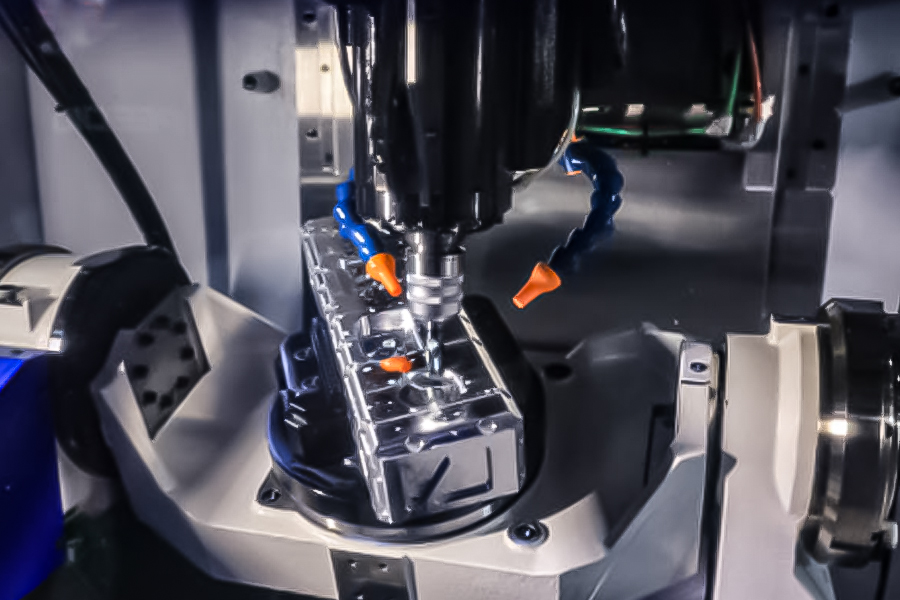
The core of the five-axis linkage CNC machining center lies in the coordinated cooperation of five motion axes, of which three linear axes (X/Y/Z) control the spatial movement of the tool, and two rotary axes (A/C or B/C) adjust the angular direction of the workpiece or tool. This multi-degree-of-freedom combination enables the tool to contact the workpiece surface from any angle, which is particularly suitable for processing complex curved structures such as aircraft blades and medical implants. To achieve high-precision synchronous motion, the equipment adopts a closed-loop servo control system to dynamically correct the trajectory deviation through real-time feedback of position data. For example, when cutting an arc contour, the CNC system will simultaneously calculate the rotation axis angle and the linear axis displacement to ensure that the cutting point is always perpendicular to the surface normal. In addition, the dynamic compensation system automatically fine-tunes the tool path by monitoring temperature fluctuations and mechanical vibrations, stabilizing the positioning accuracy within ±3 microns.
Breakthrough solution for surface machining accuracy
In response to the high-precision machining requirements of complex surfaces, the five-axis linkage CNC machining center has achieved a technological breakthrough through multi-dimensional collaborative control. The equipment uses the synchronous movement of the rotation axis and the linear axis to ensure that the tool always contacts the workpiece surface at the best angle, effectively reducing vibration and deformation during the cutting process. In order to cope with interference factors such as temperature fluctuations and material stress, the dynamic compensation system monitors the machining status in real time and automatically corrects the tool path deviation, with precision control within ±3 microns. Taking the aircraft engine blade as an example, the surface contour error is compressed to 1/20 of the diameter of a hair, meeting the stringent requirements of aerodynamic performance. Through the intelligent tool path optimization algorithm, the system can also improve processing efficiency by 30%, while avoiding the problem of surface quality degradation caused by path overlap.
Intelligent tool path optimization dynamic compensation
The modern five-axis machining system realizes accurate planning and dynamic adjustment of tool paths through intelligent tool path optimization technology. When processing complex surfaces or special-shaped structures, the control system analyzes the three-dimensional data of the workpiece in real time and automatically generates a motion trajectory that can avoid interference areas and reduce idle tool time. This algorithm not only considers the contact angle between the tool and the workpiece, but also adjusts the cutting parameters according to the material characteristics, such as automatically reducing the feed rate when processing titanium alloy to avoid overheating.
The dynamic compensation system plays a key role in this process, continuously monitoring variables such as machine tool spindle vibration and temperature deformation through high-precision sensors. When it is detected that the tool has a micron-level offset due to long-term processing, the system will recalculate the compensation value within 0.01 seconds to ensure that the cutting point always coincides with the preset path. This closed-loop control mechanism is particularly suitable for multi-angle processing of medical device joint components, and can maintain a positioning accuracy of ±3 microns even after 12 hours of continuous work. By deeply integrating path optimization with real-time compensation, the five-axis linkage equipment has successfully broken through the problem of precision attenuation caused by thermal deformation and mechanical wear in traditional processing.
Application of zero-error manufacturing of special-shaped parts
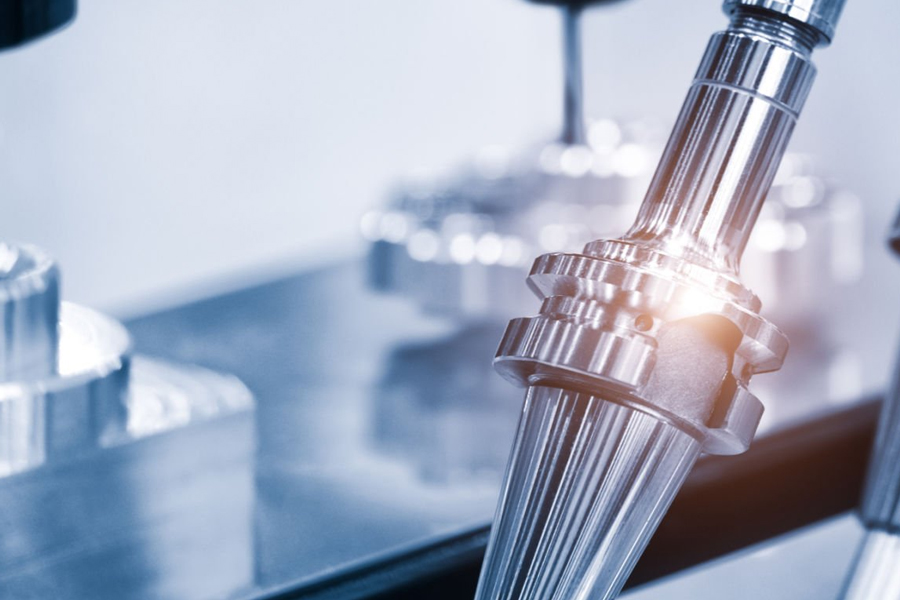
Facing the processing needs of complex curved surfaces and irregular structures, the five-axis linkage CNC machining center has shown unique advantages. In the field of aerospace, special-shaped parts such as engine turbine blades need to take into account aerodynamics and structural strength. Traditional processing is prone to error accumulation due to multiple clamping. Through intelligent tool path optimization technology, the system can automatically plan the tool path to avoid vibration problems caused by material properties or geometric mutations; the dynamic compensation system monitors the processing status in real time, automatically adjusts the spindle speed and feed rate, and controls the error of thermal deformation and mechanical vibration within ±3 microns. Artificial joint manufacturing in the field of medical devices also benefits from this technology. Complex biocompatible surfaces can be precisely processed after one clamping, and the surface roughness can reach Ra0.2μm or less, meeting the strict standards of human implants.
The innovative application of five-axis linkage CNC machining technology provides a reliable path to solve the manufacturing problems of complex curved surfaces and special-shaped parts. Through multi-angle collaborative cutting and real-time dynamic compensation, the equipment can automatically correct errors caused by material deformation or tool wear during processing, ensuring that key dimensions are stable within the micron-level accuracy range. The intelligent tool path optimization system further improves processing efficiency, predicts the best combination of tool paths through algorithms, and reduces time loss caused by empty travel and repeated positioning. In the aerospace field, this technology achieves high consistency in the production of aerodynamic surfaces of turbine blades; in medical device manufacturing, it helps special-shaped parts such as artificial joints achieve a near-perfect surface finish. These achievements not only verify the engineering value of five-axis linkage technology, but also promote the continuous progress of precision manufacturing towards the goal of zero error.