

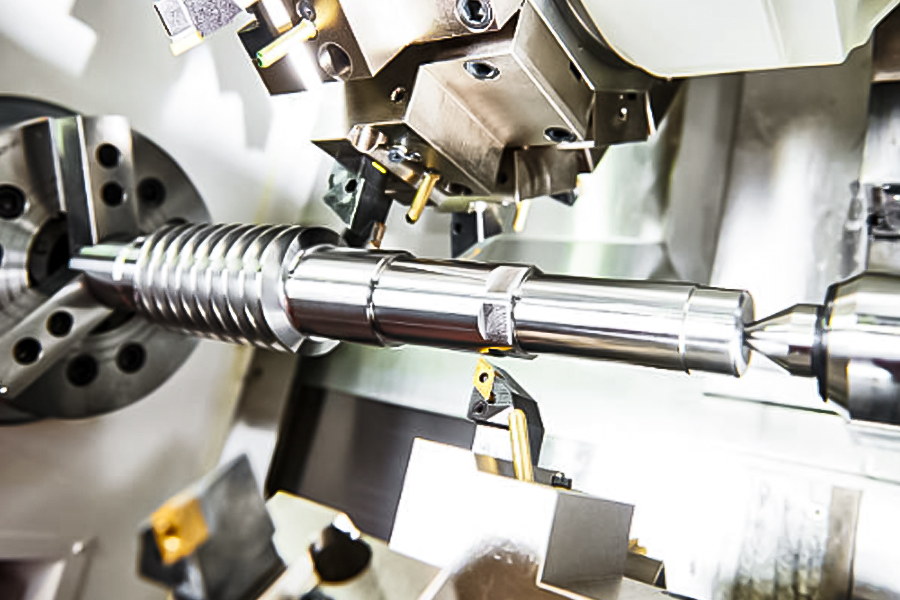
CNC turning uses a computer to control the tool to cut the rotating workpiece along a preset trajectory. It is the mainstream processing method for shaft and disc parts. Modern CNC lathes integrate functions such as automatic feeding and online detection. The processing accuracy can reach IT5 level. It is irreplaceable in the mass production of automobile bearings, hydraulic valve bodies and other parts.
Technical characteristics and process advantages
Compared with traditional lathes, the core advantages of CNC turning lie in three points: first, micron-level feeding accuracy is achieved through servo system control; second, programmable characteristics support efficient processing of complex threads and cones; third, after being equipped with a power turret, it can complete complex operations such as milling and drilling. In the precision machining system, CNC turning is often used in conjunction with a five-axis machining center. The former is responsible for the rough machining of the rotating body, and the latter is for refined feature processing.
Application expansion and innovation direction
From watch gears to oil pipeline joints, CNC turning technology has penetrated every corner of industrial manufacturing. In emerging applications, ultra-precision turning can process the aspheric substrate of infrared lenses; micro-turning technology can manufacture micro probes with a diameter of 0.1mm. With the application of technologies such as linear motors and hydrostatic guides, modern CNC lathes are continuously evolving towards high speed and high stability.
The digital rebirth of the art of rotation
CNC turning pushes the process of metal plastic forming to a new level with repeatable and precise motion, providing basic support for large-scale precision manufacturing.
Frequently Asked Questions
Q: Can CNC turning only process circular parts?
A: It is mainly for rotating bodies, but through special fixtures and programming, it can also process special-shaped cross-section workpieces such as polygons.
Q: How to control the surface roughness of turning?
A: Through the optimization of tool geometry parameters, cutting fluid selection and speed feed matching, an ultra-fine surface of Ra0.4μm can be achieved.